Christ Χριστός ΧΣ ΧΣς: Chi-Sigma-Stigma is the form in the oldest manuscripts containing Rev 13:18 P_47
We cannot count "Christ"?
We can count "words of Christ" or "deeds of Christ",
but we cannot count "Christ".
Like Water, Christ has no Plural forms.
The χΞς of χς, The AntiChrist of Christ, is The Countable of Uncountable, like The Cup of Water.
The χΞς χΣς χΙς χως Anti-Christ is like many ImageS(countable).
Imageology: The study of images, especially those produced by medical imaging.
It is the Image of Christ Marked on our Foreheads that thru are we Saved? Count/Vote for your New Messiah? Rejoice and Sing for as lightning that comes from the east is visible even in the west,
so will be the coming of the Son of Man.
Who then is the faithful and wise servant,
whom the Master has put in charge of the servants in his household to give them their FOOD at the proper time?
It will be good for that servant whose Master finds him doing so when He returns!!!!!
For we do not wrestle against flesh and blood,
but against the Rulers,
against the Authorities,
against the cosmic powers over this present darkness,
against the spiritual forces of evil in the heavenly places. שׂש س
Therefore take up the whole armor(A-Z) of God,
that you may be able to withstand in the evil day,
and having done everything,
to stand firm.
People worship idols they do not know, they create an Image of the Idol to Worship thru words/letters/books, never even to have seen the idol before?
They manipulate thru letters aka
(idols of mens law ѯ) but when exposed to the Light of Christ they are revealed!
Some are noble paths and some are racist evil paths.
They make up Gods Law using χξς and use it as a weapon to keep their jobs.
If men keep playing god & leading themselves and others to Hell, the real Beast might just show up!
Most Kings & Politicians over the past 2000 years have went thru great expense & trouble
to make either themselves or their enemy the Beast!
But woe to you Scribes and Pharisees, Imams, Pastors, Rabis, Isis, you Hypocrites!
For you shut the Kingdom of Heaven in people's faces.
For you neither enter yourselves nor allow those who would enter to go in.
By this it is evident who are the children of God,
and who are the children of the devil:
whoever does not practice righteousness is not of God,
nor is the one who does not love his fellow man.
Take no part in the unfruitful works of their darkness,
but instead expose them!
orginal website, posted ~2000
chi xi stigma?
For
I testify unto every man that heareth the words of the prophecy of this
book, If any man shall add unto these things, God shall add unto him
the plagues that are written in this book:
And if any man shall take away from the words of the book of this
prophecy, God shall take away his part out of the book of life, and out
of the holy city, andfromthe
things which are written in this book.
Revelation Chapter 13 verse 18.
|5602| Here
|4678| wisdom
|2076| is.
|3588| The
|9999| {one}
|2192| having
|3563| reason
|5585| let him count : from GSN5586; (generally) to compute, give one's vote by casting a pebble into the urn, to decide by voting
|3588| the
|0706| a number (as reckoned up): an indefinite number, a multitude gk(arithmos) from gk airo 142
|3588| of the
|2342| beast. gk Therion 2342 same as 2339; a dangerous animal, bestial man:
|0706| a number (as reckoned up): an indefinite number, a multitude gk(arithmos) from gk airo 142
|1063| and, as, because (that), but, even, for, indeed, no doubt,
seeing, then, therefore, verily, what, why, yet
|0444| man-faced, i.e. a human being, merchantman
|2076| he (she or it) is
|2532| and, also, even, so then, too, etc.
|3588| the, this, that, one, he, she, it, etc
|0706| a number (as reckoned up): an indefinite number, a multitude gk(arithmos) from gk airo 142
|0846| of it
|1812| hexakosioi (600)
|1835| hexekonta (60)
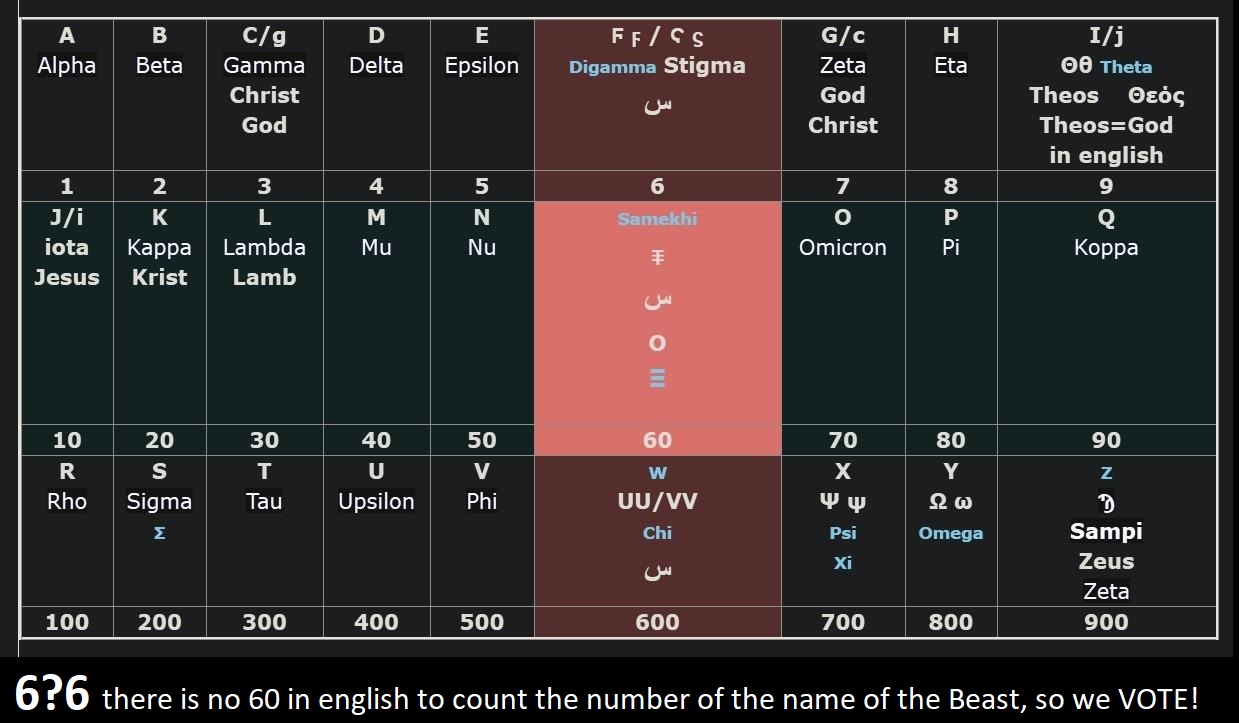
|1803| hex. (6) or |5516| chi xi stigma
According to the transcription of the INTF, the manuscript would've read [χξς] η χις (666 or 616), therefore not giving a definite number.
Here is wisdom. Let him that hath understanding count the number of the Beast: for it is the number of a man; and his number (the indefinite article form of Χς).
Here is wisdom. Let him that hath understanding count the number of the Beast: for it is the number of a man; and his number (the definite article form of Χς).
Just something to think about!
It should be stated and remembered what stigma means!
Strong's Number: 4742
Transliterated: stigma
Phonetic: stig'-mah
Text: from a primary stizo (to "stick", i.e. prick); a mark incised or punched (for recognition of ownership)ن, i.e. (figuratively) scar of service: --mark.
Quote:
The Greek language formed the basis of some of the mathematical words we use today.
The word geometry comes from a Greek word for "earth measuring."
Another modern word that comes from Greek is arithmetic, which comes from arithmos.
The Greeks had fun with numbers, and arithmos, which means number, denoted discovering secrets and figuring out puzzles about numbers. The Greek sense of curiosity about numbers probably helped them unravel many problems that earlier mathematicians could not figure out. The Greeks loved to argue, debate, and figure out how to prove everything they observed.
Strong's Number: 142
Transliterated: airo
Pronounced ah'-ee-ro
a primary root; to lift up; by implication, to take up or away; figuratively, to raise (the voice), keep in suspense (the mind), specially, to sail away (i.e. weigh anchor); by Hebraism [compare HSN5375] to expiate sin:
KJV--away with, bear (up), carry, lift up, loose, make to doubt, put away, remove, take (away, up).
Strong's Number: 1812
Transliterated: hexakosioi
Phonetic: hex-ak-os'-ee-oy
Text: plural ordinal from 1803 and 1540; six hundred: --six hundred.
Strong's Number: 1835
Transliterated: hexekonta
Phonetic: hex-ay'-kon-tah
Text: the tenth multiple of 1803; sixty: -- sixty[-fold], threescore.
Strong's Number: 5516
Transliterated: chi xi stigma
Phonetic: khee xee stig'-ma
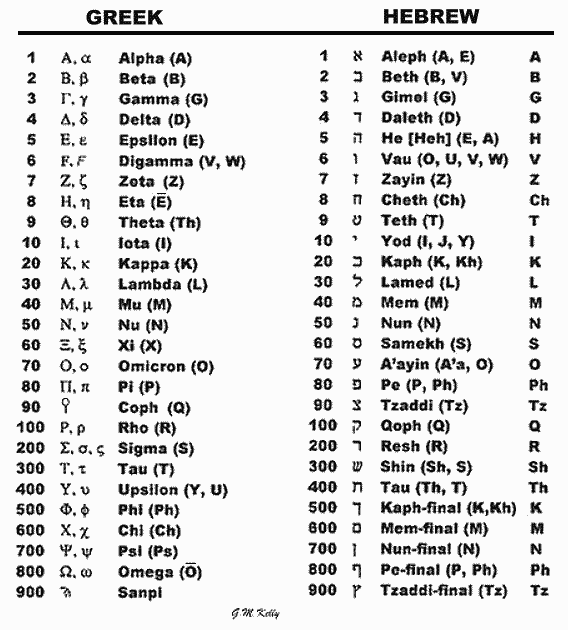
Text: the 22d, 14th and an obsolete letter (4742 as a cross) of the
Greek alphabet (intermediate between the 5th and 6th), used as numbers;
denoting respectively 600, 60 and 6; 666 as a numeral: --six hundred
threescore and six.
Strong's Number: 4742
Transliterated: stigma
Phonetic: stig'-mah
Text: from a primary stizo (to "stick", i.e. prick); a mark incised or
punched (for recognition of ownership), i.e. (figuratively) scar of
service: --mark.
Strong's Number: 0444
Transliterated: Anthropos
Phonetic: anth'-ro-pos
Text:
1. a human being, whether male or female
1. generically, to include all human individuals
2. to distinguish man from beings of a different order
1. of animals and plants
2. of from God and Christ
3. of the angels
3. with the added notion of weakness, by which man is led into a mistake or prompted to sin
4. with the adjunct notion of contempt or disdainful pity
5. with reference to two fold nature of man, body and soul
6. with reference to the two fold nature of man, the corrupt and the truly Christian man, conformed to the nature of God
7. with reference to sex, a male
2. indefinitely, someone, a man, one
3. in the plural, people
4. joined with other words, merchantman
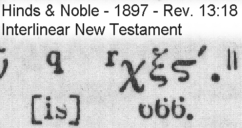
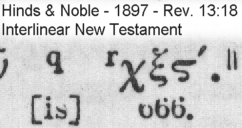
Shown at
side is the "Chi" "Xi-(small letter), & "Stigma"
Text (Rev. 13:18) in glass display at Bob Jones University Library -
Greenville, S.C.
The hook is not an underline of the date.
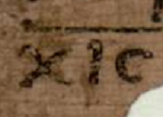
Greek text
showing Rev. 13:18 "number name"
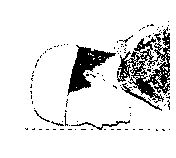
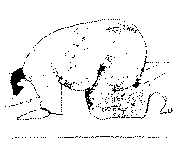
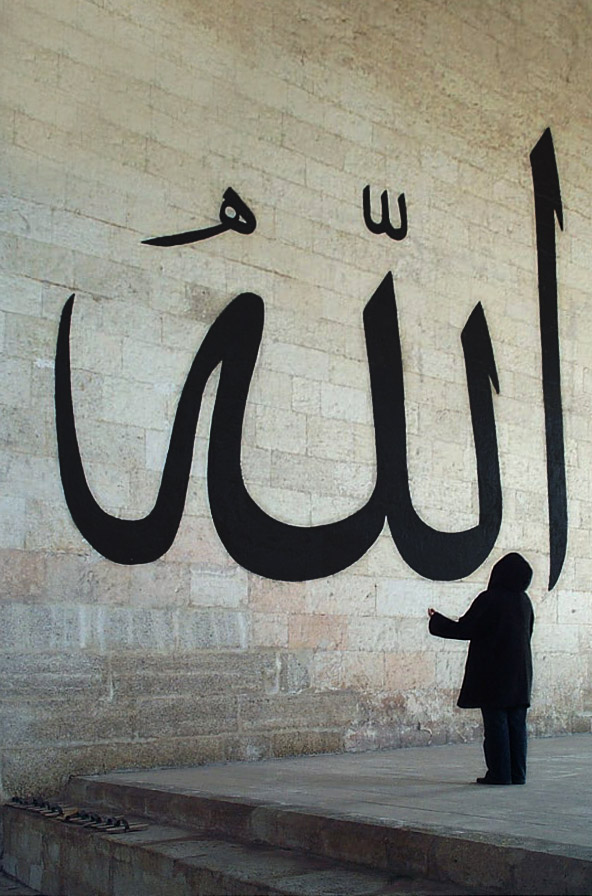
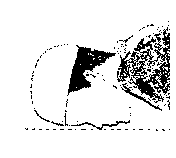
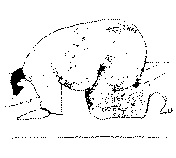
Do any of you see
anything similar compared to the image below?
You might have to tilt your head to the left!
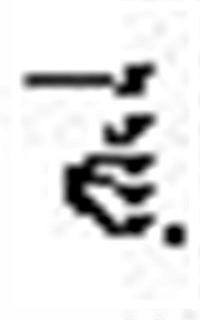
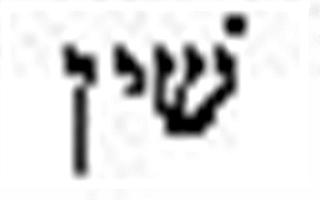
The word for Allah in Arabic but looks like the symbol for "A Spirit" either good/evil
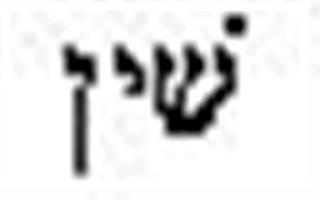
Σѯξ ع is not the same as שׂש س
Σѯξ ع stands for Scribes,
Pharisees, Imams, Pastors, Rabi's, leaders, & shaman, etc rather good/evil?
and the other שShinis for a Spirit rather good/evil
Unholy men worship these idols as gods!
In Judaism
Shin also stands for the word Shaddai,
a name for God. Because of this, a kohen (priest) forms the letter Shin
with his hands as he recites the Priestly Blessing.
In the mid 1960s, actor Leonard Nimoy used a single-handed version of
this gesture to create the Vulcan hand salute for his character, Mr.
Spock, on Star Trek
Quote:
Strong's
Number: 444
Transliterated: anthropos
Phonetic: anth'-ro-pos
Text: from 435 and ops (the countenance; from 3700); man-faced, i.e. a
human being: --certain, man.
Strong's Number: 706
Transliterated: arithmos
Phonetic: ar-ith-mos'
Text: from 142; a number (as reckoned up): -- number.
Strong's Number: 846
Transliterated: autos
Phonetic: ow-tos'
Text: from the particle au [perhaps akin to the base of 109 through the
idea of a baffling wind] (backward); the reflexive pronoun self, used
(alone or in the comparative 1438) of the third person , and (with the
proper personal pronoun) of the other persons: --her, it(-self), one,
the other, (mine) own, said, ([self-], the) same, ([him-, my-, thy-
])self, [your-]selves, she, that, their(-s), them([-selves]),
there[-at, - by, -in, -into, -of, -on, -with], they, (these) things,
this (man), those, together, very, which. Compare 848.
Strong's Number: 1063
Transliterated: gar
Phonetic: gar
Text: a primary particle; properly, assigning a reason (used in
argument, explanation or intensification; often with other particles):
-- and, as, because (that), but, even, for, indeed, no doubt, seeing,
then, therefore, verily, what, why, yet.
Strong's Number: 2076
Transliterated: esti
Phonetic: es-tee'
Text: third person singular present indicative of 1510; he (she or
it) is; also (with neuter plural) they are: --are, be(-long), call, X
can[-not], come, consisteth, X dure for a while, + follow, X have,
(that) is (to say), make, meaneth, X must needs, + profit, + remaineth,
+ wrestle.
Strong's Number: 2532
Transliterated: kai
Phonetic: kahee
Text: apparently, a primary particle, having a copulative and sometimes
also a cumulative force; and, also, even, so then, too, etc.; often
used in connection (or composition) with other particles or small
words: --and, also, both, but, even, for, if, or, so, that, then,
therefore, when, yet.
Strong's Number: 3588
Transliterated: ho
Phonetic: ho
Text: including the feminine he {hay}; and the neuter to {to}; in all
their inflections; the def. article; the (sometimes to be supplied, at
others omitted, in English idiom): --the, this, that, one, he, she, it,
etc.
Playing aound with letters.
And he causeth all, both small and great, rich and poor, free and bond,
to receive a mark in their right hand, or in their foreheads:
“And when
you pray, do not be like the hypocrites, for they love to
pray to be seen by others. Truly I tell you, they have
received their reward in full.But when
you pray, go into your room, close the door and pray to your Father,
who is unseen(Not an idol in the desert). Then your Father, who sees what is done in secret, will
reward you.And when
you pray, do not keep on babbling like pagans, for they think they will
be heard because of their many words.Do not be
like them, for your Father knows what you need before you ask him.
“This,
then, is how you should pray:
“ ‘Our
Father in heaven,
how Holy
be your name,
your
Kingdom come,
your Will
be done,
on earth
as it is in Heaven.
Give us
today our daily bread.
And
forgive us our debts,
as we also
have forgiven our debtors.
And lead
us not into temptation,
but
deliver us from the evil one.
For if you
forgive other people when they sin against you, your heavenly Father
will also forgive you.
But if you
do not forgive others their sins, your Father will not forgive your
sins!
Quote:
P47
is from the third century and is the oldest
manuscript
of the Book of Revelation. It contains parts of chapters 9-17.
We will consider its readings for numbers in Rev 13:18 and
neighboring verses in the next section.
Because, as listed above, the majority of the manuscripts
(mostly late Byzantine miniscule manuscripts) include the
representation of the number six hundred sixty-six by the three
letters (chi)(xi)(stigma), the text presented in another modern
(but non-standard) edition called not surprisingly THE GREEK NEW
TESTAMENT ACCORDING TO THE MAJORITY TEXT, does so also.[20] Note
that there is a major disagreement in presuppositions about the
value of various manuscripts and manuscript groups between the
editors of this edition and those of the standard editions.[21]
The so-called Textus Receptus which acted as the standard
from the 16th century (the actual term first being used in the
17th) until well into the 19th century when modern critical
editions started to displace it, was an evolution of early
printed editions of the Greek NT. Its printed text also used the
(chi)(xi)(stigma) notation. The main textual basis of this
edition was only a handful of fairly late manuscripts, a subset
of the majority text.
VI. Papyrus P47 in Detail on the Numbers of Rev 13:18
As mentioned above, P47 is the oldest extant manuscript
which contains part of the Book of Revelation. However, its
method of representing the number six hundred sixty-six (using
Greek alphabetic numerals) is not the one selected by the
"standard" critical text (which spells out the number words).
The textual apparatus of NA26 shows other variations of P47 from
the usual text, even in other places in Rev 13:18.
Although the use of a modern printed critical edition of the
Greek New Testament is within the ability of anyone who can read
the Koine Greek, the potential of looking at actual copies
(reproductions) of individual manuscripts is slight. Even many
theological libraries would not have the printed (published)
editions which would contain photographs of the desired
manuscript.
In this case we are lucky because Kurt and Barbara Aland in
their widely available textbook (pun-intended) THE TEXT OF THE
NEW TESTAMENT (in both the first and second English editions of
1987 and 1989) include a Plate 23 on
page 90 which shows
Rev 13:16-14:4 of P47. (Note that the caption of this plate is
incorrect in that it attributes P47 to the the second century
whereas in other places in the book they give the usual third
century date).
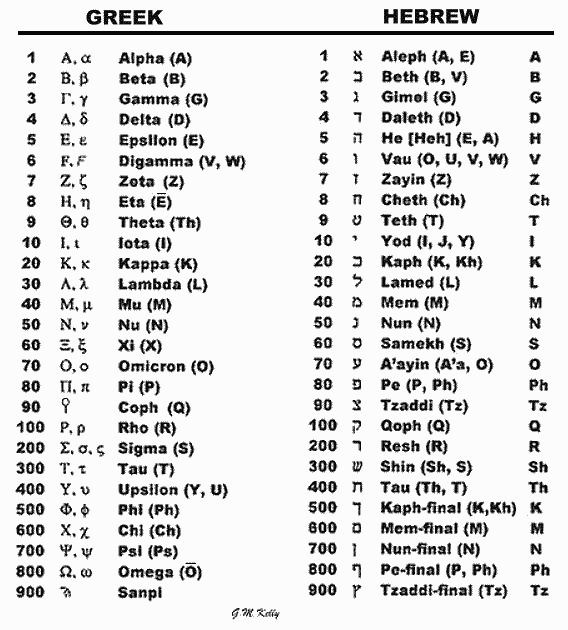
As mentioned in the description of the Greek alphabetic
number system above, the usual way to signal that letters are
being used as numerals is by a horizontal line above the
letter-numbers. (A horizontal line can also mean something
else.)
On the ninth line down from the top of this fragment (all
line counts will exclude what might be counted as the first line
which seems to include only one character at the very top of the
plate) we can see the first horizontal line overscore. This is
indeed over the three letters
(chi)(xi)(stigma) which represents
the six hundred sixty-six of Rev 13:18.
The
earliest of these Greek New Testament manuscripts are the papyri. They
are given that name because they are written on papyrus, an ancient
type of writing material made from the fibrous pith of the papyrus
plant, which in ancient times grew plentifully along the river Nile.
Eighty-one of these papyri have now been discovered, many of them mere
fragments. (4)
The most important of these papyrus manuscripts are the Chester Beatty Papyri
and the Bodmer Papyri. The Chester Beatty Papyri were published in
1933-37. They include Papyrus 45 ( Gospels and Acts, c. 225 A.D. ),
Papyrus 46 (Pauline Epistles, c. 225 A.D.), and Papyrus 47 (Revelation, c. 275 A.D.
).
So we turn our attention from p47 to Chester Beatty!
Quote:
The Chester Beatty Papyri
"The Chester Beatty Papyri is the name of a group of biblical
manuscripts acquired mainly in 1930 by A. Chester Beatty, an American
collector. The had been discovered at Aphroditopolis, N. of Memphis in
Egypt, probably originating from the library of a Christian church.
The manuscripts are substantial portions of papyrus codices: (1) seven
from the OT, including large parts of Genesis, Numbers, Deuteronomy,
Isaiah, Jeremiah, Daniel, Esther, and Ecclesiastes; (2) three from the
NT, containing the Gospels with Acts, the Pauline Epistles, and
Revelation; (3) one with part of the pseudepigraphical Book of Enoch
and a second century homily of the passion.
The number of surviving leaves in these codices varies greatly, the
most remarkable being P46 (Pauline Epistles and Hebrews) with 86 nearly
complete leaves out of a total of 104. After Beatty acquired the
original 10, the University of Michigan acquired another 30, and Beatty
another 46, all from the same codex. This collection of papyri, dated
to the second and third centuries A.D., provides important textual
evidence for OT and especially NT prior to the great vellum codices of
the fourth century and later."
Bruce F. Harris, Contributor "Dictionary of Biblical Archaeology"
(Grand Rapids, Michigan: Zondervan 1983) p. 127
Photographic
facimilies have been created for each page and are available for study.
All of the verses which we have from them have been edited by Frederic
Kenyon. The have also been made available in the critical text of Erwin
Nestle's translation of the New Testament (title: Novum Testamentum
Graece).
Most modern versions/translations of the New Testament in English are
based upon this text, so the Chester Beatty Material is imbedded within
the translation wherever extant material was available to impact or
contribute to the text.
This entire work is based on a compilation mostly of the Chester Beatty
material, but also includes the other ancient Greek documents of the
New Testament.
I would recommend that you buy Nestle's Greek Text of the New
Testament, start learning Greek, and you will be reaching your stated
objective, since the Chester Beatty material is there.
https://en.wikipedia.org/wiki/Nomina_sacra means "sacred names" inLatinand refers to the Christian scribal practice of abbreviating several frequently occurring divine names or titles, especially inGreekmanuscripts ofHoly Scripture. Anomen sacrumconsists of two or more letters from the original word spanned by anoverline. In the system ofnomina sacrathat came to prevail, abbreviation is bycontraction, meaning that the first and last letter (at least) of each word are used. Using
the normal list of numerical values, the total value of the letters in
Jesus σταυρος is 1,270. But if the first two letters are combined
as the obsolete letter stau, or stigma, then the numerical value of
ϛ+α+υ+ρ+ο+ς = 6+1+400+100+70+200 = 777 Then is created a stupid religion because of numerology where men decides the number of the Beast & can create a new Language to hide the Beast's Image and Name.
Numerology is
any belief in the divine, mystical relationship between a number and
one or more coinciding events. It is often associated with the
paranormal...nope its just gk(arithmos)
its not sacred but
a number!
examples of Nomina sacra: Jesus Christ Ἰησοῦς Χριστός ΙΣ ΧΣ What Nomina sacra word does this stand for χι
p46 2 Corinthians 11:33-12:9nomen sacrum of Christo χω God θς Papyrus
46 (in the Gregory-Aland numbering), scribal abbreviation P46, is one
of the oldest extant New Testament manuscripts in Greek, written on
papyrus, with its 'most probable date' between 175-225ad. Just for reference the number 800 in greek/idol is ω'
666 First comes the shaman(false prophet) Σ ξ ع then comes a spirit ο ש س ?
616 If ו iota 10 then? or if Σ back to 666 formula?
ס or c Letter used alone to mark the end of a Sacred text or stigma!
This applies to any Religion on the planet if the Goverment can change the ABC's anti-sigma?
Also could apply to Hitler or any Leader voted into office? UnGodly men blindly following their new Messiah?
Beats me, 666 reminds us of evil because we have been taught that Image of it. Maybe thats the point? Another idol?
In the NT they used Ø Theos Greek for God
Øשׂשس Quit Worshipping Letters as Idols & focus on Christ Jesus the Alpha & Omega!
Also the top line above the 666 is to represent a number in Greek but
it doesn't fully cover the last letter. Odd
The last letter could be a six or a 60 or probaly better the word Stigma, which matches the verses before it in Revelation Chapter 13 verse 16-17.
16. And he causeth all, both small and great, rich and poor, free and bond, to receive a mark in their right hand, or in their foreheads:
17. And that no man might buy or sell, save he that had the mark, or the name of the beast, or the number of his name.
If ya change the sigma then what?
Also let's not forget what stigma means!
Strong's Number: 4742
Transliterated: stigma
Phonetic: stig'-mah
Text: from a primary stizo (to "stick", i.e. prick); a mark incised or punched (for recognition of ownership), i.e. (figuratively) scar of service: --mark.
More research!
Matthew
24 Take heed that no man deceive
you. For many shall come in my name,
saying, I am Christ; and shall deceive many. And ye shall hear of wars and
rumours of wars: see that ye be not troubled: for all these
things must come to pass, but the end is not yet.
For nation shall rise against
nation, and kingdom against kingdom: and there shall be famines, and
pestilences, and earthquakes, in divers places. all of
these are the beginning of sorrows.
Then shall they deliver you up
to be afflicted, and shall kill you: and ye shall be hated of all
nations for my name's sake.
And then shall many be offended,
and shall betray one another, and shall hate one another.
And many false prophets shall
rise, and shall deceive many.
And because iniquity shall
abound, the love of many shall wax cold.
But he that shall endure unto
the end, the same shall be saved.
And this gospel of the kingdom
shall be preached in all the world for a witness unto all nations; and
then shall the end come.
Immediately after the
tribulation of those days shall the sun be
darkened, and the moon shall not give her
light, and the stars shall fall from
heaven, and the powers of the heavens
shall be shaken: And then shall appear the sign
of the Son of man in heaven: and then shall all the tribes of
the earth mourn, and they shall see the Son of
man coming in the clouds of heaven with power and great glory. And he shall send his angels
with a great sound of a trumpet,
and they shall gather together
his elect from the four winds, from one end of heaven to the
other.
Search for 'Revelation 13:18' in the
Greek NT versions
"The Greek New Testament is the New Testament; all else is
translation". A. T. Robertson
A few sites I ran across doing research.
As with
everything take these with a grain of salt. I haven't fully
investigated these places but they offer some insight nonetheless.
Quote:
Revelation
13:12 "And he exerciseth all the power of the first beast before him,
and causeth the earth and them which dwell therein to worship the first
beast, whose deadly wound was healed."
Now we see the people worshipping the first beast. Is there
evidence of people worshipping a city? Yes. The faithful turn toward
Mecca at prayer time. They bow down on their faces in worship.
There have been many throughout history that have given allegiance to a
particular city like Rome, Babylon, Sparta, Jerusalem, Memphis, Thebes,
Thessalonica, Ephesus, and on and on the list could go. Allegiance is
akin to worship. It is not a great step to take to worship the
political system of antichrist.
Again,
during the second half of the Tribulation--the forty-two months when
the composite first beast of Revelation 13 is allowed to exercise
authority received from the dragon (Rev 13:5)--all of humanity will
have received the Holy Spirit. All will be spiritual Israelites. There
will only be one faith: Christianity. And the saints will be divided
between those who have accepted the mark of the beast (Chi xi stigma,
or the tattoo of the Cross) and worship the beast, and those who refuse
the tattoo and refuse to worship the beast. Those who refuse to worship
the image of the beast will, likely, be slain (v. 15), especially if
they are not inside the walls of spiritual Jerusalem, which has
theological rather than geographical coordinates.
The prophecy pundits find in Islam the endtime boogie-man, but
Islam today accepts Christ as a prophet. It will not be a far step for
Muslims to accept the man of perdition as a genuine prophet, and for
the entire faith to convert to Arian Christianity.
Islam presently has a recognizable flaw: there is no criteria by
which a person can be certain of going to heaven other than dying in
Jihad. A person can never be certain that he or she is good enough to
go to heaven. As a result, the culture doesn’t admit blame. It can’t
and still have any chance of being with Allah. So the Islamic belief
paradigm needs the means of suspending the death penalty for sin for
long enough that a person can mend his or her ways. The paradigm needs
grace. And the man of perdition will, with charisma, explain to Islamic
clerics why they must accept Arian Christianity to stop their young
people from blowing themselves up--only the man of perdition can stop
Islamic terrorism. And while wearing out Sabbath-keeping saints, this
man of perdition will permanently put an end to terrorism. Remember,
the whole world follows the beast, and worships the dragon and the
beast and even the image of the beast. The world won’t worship the
beast, or anyone else without cause. Hitler seemed like a German savior
because he put an unemployed nation to work. The man of perdition will
seem like a Christian savior for he will finally win the Crusades by
bringing Christ to the 10-40 window.
Two
papyri finds that are of importance, as far as we are concerned, are
the Chester Beatty Papyri and the Bodmer Papyri. The former, three
manuscripts designated as P45 , P46 and P47,
were named after the American millionaire, Alfred Chester Beatty who
bought the fragments in 1931 in an Egyptian black market. P46, dated to
the around 200 CE, contains the letters of Paul (but is missing some
parts and is lacking completely in the pastorals, II Thessalonians and
Philemon ). P45 and and P47, are both dated to the third century CE.
The former consists of the gospels and Acts (beginning from Matthew
20:24 and ending at Acts 17:17 but with a lot of gaps) while the latter
are fragments from the book of Revelation (Rev 9:10-17:2 with some
gaps).
What is the Peshitta?
Quote:
The
standard Bible of the Syrian Church is the Peshitta. The Peshitta, of
which there are 350 extant manuscripts, contains 22 books of the New
Testament but lacks II & III John, II Peter, Jude and
Revelation-which the Syrian Church does not accept as canonical. Like
the Vulgate, the Peshitta betrays the work of many hands (attempted
corrections and revisions) and is of limited significance textually.
Other Syriac versions include the Harklensis/Philoxeniana (Syrh), which
may have some textual significance, and the Palestinian Syriac.
Manuscript Evidence for Disputed Verses
Quote:
Revelation 13:18
The RSV, LB and NASV have a marginal note to the effect that some
manuscripts read 616, instead of 666.
Burgon (14) p 135-7, (32) p 110, 148, states that the authorities for
the alternative reading consist only of uncial C, cursive 11 and one
father, Tichonius (4th cent.). All other copies of Revelation and all
versions support the reading "666," which is also confirmed by Irenaeus
(170 AD), Origen and Hippolytus (each 3rd cent.), Eusebius (4th cent.),
Victorinus (5th cent), Primasius (6th cent.) and Andreas (7th cent.)
and Arethas (l0th cent.).
Among
the more interesting readings found in these papyri, two are especially
noteworthy. Ì106 (III century) reads oJ ejklektov" at John 1:34,
in
agreement with Ì5vid a* itb, e, ff2* syrs,c. Although the
UBSGNT4
committee rejects this reading in favor of oJ uiJov" (giving the latter
a B rating), that decision will surely have to be revisited in light of
now clear Greek testimony from the third century1 for oJ ejklektov". As
Head notes (11), “This early support in Greek, Latin and Syriac
indicates a geographical diversity behind this reading.” Ì115
(III/IV
century) is now apparently our earliest witness to the AC text of the
Apocalypse. This MS includes twenty-six fragments of Revelation,
covering portions of chapters 2 through 15. Not only is it an early
witness to the AC text (the most important textual strand for the
Apocalypse), but it also is the earliest witness to the reading “616”
at Rev 13:18.
hmm John knew hebrew also, let's do some
research there also?
hebrew shin ~ sin
Quote:
The
letter shin appears engraved on both sides of the head- tefilin. On the
right side, the shin possesses three heads, while on the left side it
possesses four heads. In Kabbalah we are taught that the three-headed
shin is the shin of this world while the four- headed shin is the shin
of the World to Come.
The
Letter Shin is easily distinguished by its three heads. The spacing of
the Shin is something that takes practice for a Sofer to write
correctly. The leftmost leg should have the head of a Zayin. (According
to the Arizal,the left leg has the head of a Vov.) The head should have
3 Tagin on it, like a regular Zayin. The heads should not touch one
another at all. Also, there should be no more than 3 heads in total, or
the letter would be rendered invalid. The bottom should come to a
point, and not be rounded or flat.
The Letter Shin is equal to 300. The Letter Tof is equal to 400.
Basically, you would put the letters together to equal the number you
are seeking e.g. - 22 would be CHOF-BEIS. However, if you wanted to
write out the number fully, like when we write seventy one in English
instead of 71, you would need to know the Hebrew words for seventy and
one and put them next to one another. Finally, keep in mind that in
Hebrew they also use the numbers 1234567890, and so even though they
are not Hebrew characters, they are universally known and used by the
name Arabic characters.
In
at-bash , the Name Havayah transforms to mem, tzadik, pei, tzadik,
which equals 300, the letter shin . 300 also equals the highest "full
spelling" of God's Name Elokim. This equality implies that "Havayah
[supernatural revelation] is [absolutely one with] Elokim [natural
order]." On the head--Tefilin are inscribed two shins, one with three
heads and one with four heads. The three headed shin, the shin of this
world, represents the "full spelling" of Elokim, while the four headed
shin, the shin of the world to come, represents the at-bash
transformation of Havayah.
Remember, John was told to write what he saw. And I believe he did just that. I believe he wrote exactly what he "saw". I believe it is as simple and direct as that. I believe the scritpure (like most of the Bible) is literal. It just takes the right understanding to "see" it yourself.
He said they would wear the 666 on thier foreheads and right arms. But what did John see? Did he see "666" as we do today? No. We use Arabic numerals. In the Greek text it is represented by Greek words. Specifically: Chi Xi Stigma, or "Six-hundred, three-score and six".
So what John saw was something that looked like "Chi Xi Stigma", being worn on the foreheads and right arms of the multitude of the beast. It was also on the coinage, and everthing was done with "the mark of the beast" or "666". But what does "666" mean? Is it something we can look at today and say, "There it is!". It it something we can see? And the answer is, "yes you can".
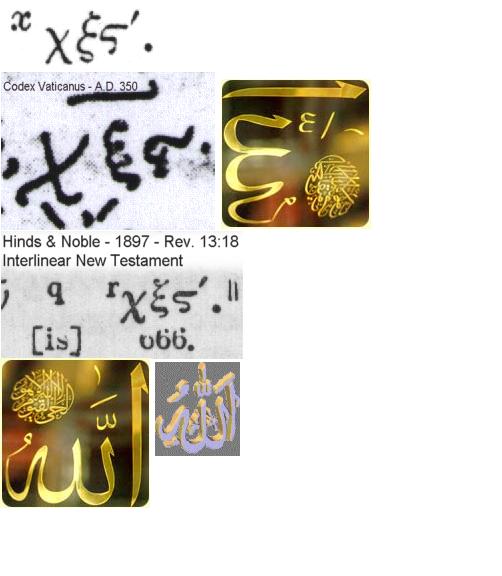
The Greek letters Chi Xi Stigma also spell a phrase in another language. And that language is Arabic. The word it spells is Bismillah, which means (literally) "In the name of Allah".
It's a mulit-lingual pallendrome. It reads left-to-right (Greek) "Chi Xi Stigma" and right-to-left (Arabic) "Bismillah".
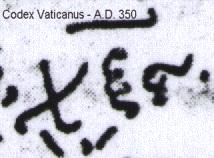
The Greek symbol for stigma (with the period because it's at the end of the verse. See: Codex Vaticanus) is exactly the same as the letter(s) that make the BSM sound in Bismillah. It looks like a bit like a capital G with a period in the middle. It's acutally the co-junction of two letters in Arabic, the B-sound and the SM-sound.
Next is Allah. Alla is spelled like the letter E laying on it's back with an extra small leg. The Greek text in the Codex V., has the extra (fourth) leg because it is hand written. If you tilt the letter about 90-degrees to the left (thus laying the E on it's back), it spells Allah in Arabic.
The Chi or "X" symbol, is commonly seen with the phrase Bismillah and represents the swords of Allah.
Now, go back and re-read that verse inserting bismillah in place of Chi Xi Stigma. It reads:
"Here is a riddle! Let him with understanding decide the multitude of the beast, for it is a multitude of people and is the same as (those), in the name of Allah"
Where do you see this today?
It is what is written on the green banners and green arm-bands that Muslims wear at the protests, rally, parades, dancing in the streets like on 9/11, etc.. It is also what the Martyrs for Islam wear on their heads and right arms when then blow themselves-up yelling "Alla Akbar", or "God is great".
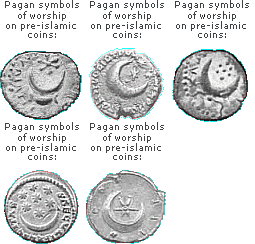
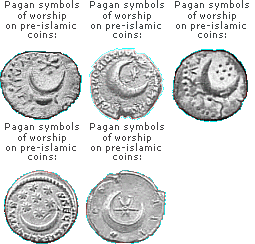
It is on the new Muslim coinage. And everthing in Islam is done, "In the Name of Allah".
Islam is the beast?
"et is dead; a member of AboveTopSecret.com";
666-where does it come from? http://www.abovetopsecret.com/forum/thread80914/pg1
Just because a group of people wish to play the beast doesnt make them the true beast, they could just be a copy of the Image χξς?
God Bless and Rejoice; for hour soon will come when all the (A-Z Beast ς) of the Earth shall be Judged!
But
if our gospel be hid, it is hid to them that are lost: In
whom the god of this world hath blinded the minds of them which believe
not, lest
the light of the glorious gospel of Christ, who
is the image
of God, should shine unto them.






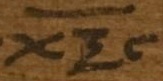
 Shown at
side is the "Chi" "Xi-(small letter), & "Stigma"
Shown at
side is the "Chi" "Xi-(small letter), & "Stigma"
 Text (Rev. 13:18) in glass display at Bob Jones University Library -
Greenville, S.C.
Text (Rev. 13:18) in glass display at Bob Jones University Library -
Greenville, S.C. 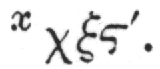 Greek text
showing Rev. 13:18 "number name"
Greek text
showing Rev. 13:18 "number name"
 The word for Allah in Arabic but looks like the symbol for "A Spirit" either good/evil


.jpg)