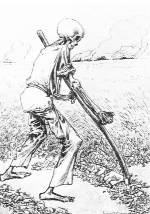
 The influenza
pandemic of 1918-1919 killed more people than the Great War, known today as World War I
(WWI), at somewhere between 20 and 40 million people. It has been cited as the most
devastating epidemic in recorded world history. More people died of influenza in a single
year than in four-years of the Black Death Bubonic Plague from 1347 to 1351. Known as
"Spanish Flu" or "La Grippe" the influenza of 1918-1919 was a global
disaster. The influenza
pandemic of 1918-1919 killed more people than the Great War, known today as World War I
(WWI), at somewhere between 20 and 40 million people. It has been cited as the most
devastating epidemic in recorded world history. More people died of influenza in a single
year than in four-years of the Black Death Bubonic Plague from 1347 to 1351. Known as
"Spanish Flu" or "La Grippe" the influenza of 1918-1919 was a global
disaster.
The effect of the influenza epidemic was so severe that the average life span in the US
was depressed by 10 years. The influenza virus had a profound virulence, with a mortality
rate at 2.5% compared to the previous influenza epidemics, which were less than 0.1%. The
death rate for 15 to 34-year-olds of influenza and pneumonia were 20 times higher in 1918
than in previous years (Taubenberger). People were struck with illness on the street and
died rapid deaths. One anectode shared of 1918 was of four women playing bridge together
late into the night. Overnight, three of the women died from influenza (Hoagg). Others
told stories of people on their way to work suddenly developing the flu and dying within
hours (Henig). One physician writes that patients with seemingly ordinary influenza would
rapidly "develop the
most viscous type of pneumonia that has ever been seen" and later when cyanosis
appeared in the patients, "it is simply a struggle for air until they
suffocate," (Grist, 1979). Another physician recalls that the influenza patients
"died struggling to clear their airways of a blood-tinged froth that sometimes gushed
from their nose and mouth," (Starr, 1976). The physicians of the time were helpless
against this powerful agent of influenza. In 1918 children would skip rope to the rhyme
(Crawford):
I had a little bird,
Its name was Enza.
I opened the window,
And in-flu-enza.
Jesus Said
" ...and there shall be FAMINES,
and
pestilences, and earthquakes, in divers
places." (Matthew 24:7)
The colour of the fourth horse is given
as deathly pale or sickly, yellowish green. Again comparing the Revelation with the
Master's Olivet prophecy we find that the sickly pale horse symbolises pestilence: deadly
disease epidemics and plagues that so quickly lay low millions of humans engulfed in war
and famine. When the pale horse breaks into a gallop it will appear as though the finely
tuned forces of nature have become dislodged. Disease epidemics of all kinds will sweep
across the globe bringing death to millions of people and their crops. The rider on the
pale horse has begun to ride below and death is following closely at his heels.
Influenza
Epidemic, 1918-19: Estimated total deaths worldwide
 13,000,000 (Gilbert) 13,000,000 (Gilbert)
20,000,000 (Encarta; Time:
Great Events of the 20th Century; 30 June 1998 Washington Post)
21,642,274 (Our Times)
30,000,000 (Wallechinsky)
Link to a PBS Special on it
"Nothing else --
no infection, no war, no famine -- has ever killed so many in as short a period. And yet it has never inspired awe."
Info from Standford University on 1918 Flu
The Story of the Great Influenza Pandemic
of 1918 and the Search for the Virus That Caused It
|

