Prophet
Messiah
Christ
Sometimes an image is worth a thousand words.
I see more Hollywood Graven Images in this search demon
Here's the other A heathen deity
Which ever one you wish to believe is fine
So
the "He who must not be named" is the Messiah "a leader/savior of a
particular group/cause" and this "is according to the working of Satan"
, and the Messiah "He who must not be named" proclaims the new
Name of God at the temple mount in Jerusalem where the Dome of
Rock now sits?
So the "He who must not be named" is the Messiah "a leader/savior of a particular group/cause" and this "is according to the working of Satan"
, and the Messiah "He who must not be named" proclaims the new Name of
the only God/Satan at the temple mount in Jerusalem where the Dome of
Rock now sits? The False Prophet gives them the voice/internet power to
speak/preach their New Gospel? Then 3 frogs show up "out of their
mouths" aka demons to gather together the nations for the final battle
to destroy Israel. How many nations around Israel are involved in this
war?
Temple is a word. In Acts it's just a word. It's a simple word.
It's a word that doesn't require an act of congress to declare it's meaning.
That only occurs if it's the word "IS" and there is confusion created by lies.
There is but 1 Temple Location on the earth that YHWH has dwelt in, not God.
Our Body is the Temple of the Holy Spirit, not God.
The word God is an english word that was made up.
There are many names of god throughout the world so
Jesus said to pray "Our Father in heaven, how Holy be your Name".
For there to be a Father there has to be Sons/Daughters!
How "Holy be thou Name" but no name is given, pretty smart if ya ask me!
This is the Antichrist, the one who denies the Father and the Son. <-Islam
Jesus Christ is the Truth and the Light! By HIS NAME only shall you be saved!
Wolf????
Fusion77
Ehh, that's alright. I'll stick to what the bible original language and translators have provided.
http://christianforums.net/Fellowship/index.php?members/fusion77.8796/
Then you should be using greek θεός Theos not
https://en.wikipedia.org/wiki/God_(word)
The Proto-Germanic meaning of *ǥuđán and its etymology is uncertain. It is generally agreed that it derives from a Proto-Indo-European neuter passive perfect participle *ǵʰu-tó-m. This form within (late) Proto-Indo-European itself was possibly ambiguous, and thought to derive from a root *ǵʰeu̯- "to pour, libate" (Sanskrit huta, see hotṛ), or from a root *ǵʰau̯-(*ǵʰeu̯h2-) "to call, to invoke" (Sanskrit hūta). Sanskrit hutá = "having been sacrificed", from the verb root hu = "sacrifice", but a slight shift in translation gives the meaning "one to whom sacrifices are made."
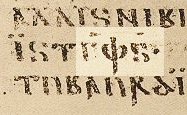 Earliest attestation of the Germanic word in the 6th century Codex Argenteus (Mt 5:34)
Gothic Bible
https://en.wikipedia.org/wiki/Gothic_Bible
Gothic Christianity differed from Catholic and Orthodox doctrine as to the divinity of Jesus, with the Gothic Christians maintaining that Jesus was a creation of God, rather than being God himself. The Goths rejected the Holy Trinity see Arianism
https://en.wikipedia.org/wiki/Arianism
Arianism is a nontrinitarian belief that asserts that Jesus Christ is the Son of God, created by God the Father, distinct from the Father and therefore subordinate to the Father. Arian teachings were first attributed to Arius (c. AD 250–336), a Christian presbyter in Alexandria, Egypt. The teachings are opposed to mainstream Christian teachings on the nature of the Trinity and on the nature of Christ. The Arian concept of Christ is
that the Son of God did not always exist, but was created by God the
Father. This belief is based on an interpretation of a verse in the Gospel of John (14:28):[1] "You
heard me say, 'I am going away, and I am coming back to you.' If you
loved me, you would be glad that I am going to the Father, for the
Father is greater than I."
Gothic Language
https://en.wikipedia.org/wiki/Gothic_language
Gothic is an extinct Germanic language that was spoken by the Goths.
Goths
https://en.wikipedia.org/wiki/Goths
The Goths (Gothic: *Gut-þiuda,[1] *𐌲𐌿𐍄𐌰𐌽𐍃, Gutans[2]; Old Norse: Gutar/Gotar; Latin: Gothi; Greek: Γότθοι, Gótthoi) were anEast Germanic people, two of whose branches, the Visigoths and the Ostrogoths, played an important role in the fall of the Western Roman Empire and the emergence of Medieval Europe.
[re'shiyth]
['elohiym] [bara']
['eth] [shamayim]
['eth] ['erets]
Revelation
13:18 Here is wisdom. Let him that hath understanding count the number
of the beast: for it is the number of a man; and his number is
| [re'shiyth] | ['elohiym] | [bara'] | ['eth] | [shamayim] | ['eth] | ['erets] |